Showing posts with label Outdoors. Show all posts

Sunday, July 18, 2010

Give Unto the LORD

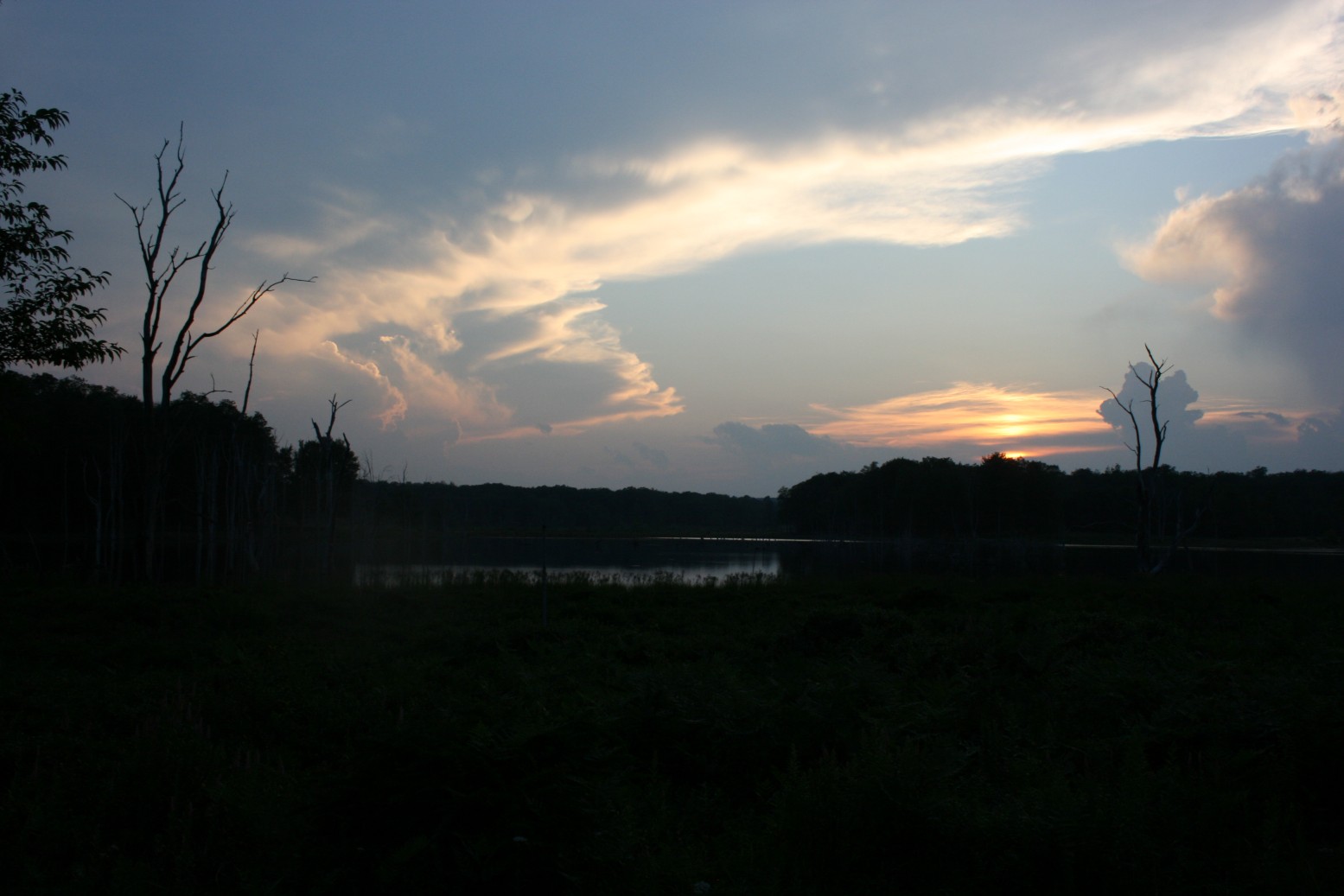
Last night Curwensville experienced the most violent electrical storm I can remember in my life. From out in the Quehanna Wild Area, I took these photos of the thunderhead as it approached.


Give unto the LORD O ye mighty,

Give unto the LORD glory and strength.

Give unto the LORD the glory due unto His name;

Worship the LORD in the beauty of holiness.


The voice of the LORD is upon many waters;

The God of glory thundereth;

The LORD is upon many waters.

The voice of the LORD is powerful;

The voice of the LORD is full of majesty.

The voice of the LORD breaketh the cedars of Lebanon;

Yea, the LORD breaketh the cedars of Lebanon.

He maketh them also to skip like a calf;

Lebanon and Sirion like a young unicorn.

The voice of the LORD divideth the flames of fire;

The voice of the LORD shaketh the wilderness;

The LORD shaketh the wilderness of Kadesh.

The voice of the LORD maketh the hinds to calve,

And discovereth the forests,

And in His temple doth everyone speak of His glory.

The LORD sitteth upon the flood;

The LORD sitteth king forever.


The LORD will give strength unto His people;

The LORD will bless His people with peace.


Psalm 29

Tuesday, August 11, 2009

Supercell

According to a National Weather Service report, a supercell thunderstorm spawned a tornado near the town of Tyler in Clearfield County on Sunday afternoon (8/9/2009). I was blessed to get a good glimpse of the storm without being near enough for trouble. Here's my picture:


I admit, this is a rather poor image. Light conditions were not very good, although it was only partly cloudy in Curwensville when I took it. The wedge shape in the sky on the left is pale blue sky. But the image is good enough to explain a few things about the storm.


To the right is the body of the storm, called a supercell thunderstorm. Any thunderstorm is caused by warm, moist air rising high into the atmosphere because of heating. As it rises, the water vapor in the air condenses and becomes clouds and rain. Sometimes the wind and rising forces are very strong, causing a strong swirling vortex to form in the middle of the storm. These storms are called supercells.


In this photo, you can see the main channel of air on the right half of the sky. These clouds are made of water that is condensing around the vortex. The friction and forces in here made a great deal of lightning. At the top of the picture, you can see what is called the "anvil" of the storm. This is where the uplifted air gets so high that it enters a cold thin part of the atmosphere where strong winds blow it out in all directions. This is somewhere between 35,000 and 50,000 feet.


Now here is the radar image from the National Center for Atmospheric Research:


This picture shows conditions about the time of the tornado. The tornado occurred in the red part directly above the letters FIG, which is Clearfield-Lawrence Airport. The storm front came through Pennsylvania from the northwest. As it approached Clearfield County, the storms were aligned along a single front, almost a straight line. You can see part of the line in the upper right-hand corner of the photo.


Notice how the portion of the storm that spawned the tornado has fallen behind the main line. If you are familiar with the geography, you will notice that it has stalled over Bennett's Valley between Weedville and Penfield along State Route 255. This is a very deep valley with Boone Mountain on the northwest and Penfield Mountain to the southeast. Apparently when the storm came directly across the valley, the face of Penfield Mountain caused the storm to stall and the winds to start spinning up to a great elevation, which eventually led to the tornado.


This is not the first time that Penfield Mountain has caused Parker Dam State Park to suffer tornadoes. The same thing happened on May 31, 1985, and you can still see the damage to this day.


Saturday, May 31, 2008

Night Birds

Go out into your yard some night and listen, and you may hear some birds that only come out after dark. One of the most common is the Common Nighthawk (click to hear). This bird flies at dusk and calls frequenly as he feeds on insects. I see and hear it commonly over the downtown areas of towns like Curwensville and Clearfield. In flight, it looks like a brown seagull.


Another bird that will sometimes fly in your neighborhood is the Great Horned Owl. Because of its reclusive habits, you'll be lucky to see this bird, unless you can startle it on its perch during the day. This is the biggest owl you'll find regularly in Pennsylvania, with a wingspan of about five feet. These birds will fly into neighborhoods, over fields, and in the deep forest looking for prey.


You'll have to venture into the woods at night to find the Eastern Screech Owl. This bird makes the spookiest of all nighttime noises. It's a little owl at about 8" high, but makes a big noise. These guys are travellers, moving miles and miles in a single night- you can track their progress across the countryside as the call periodically.


The noisiest of noisy forest birds is the Whippoorwill. These little birds will make their distinctive call for hours on end, sometimes from a single perch. If you happen to camp in one's neighborhood, you may feel like shooing him away after an hour or more of calling! The looks of this bird might explain why they fly at night (well, probably not). But they are one of the ugliest of Pennsylvania birds.


Wednesday, February 20, 2008

Birds of the Forest

If you have a bird feeder in your yard, you may have become familiar with some of the common birds of the open habitat, like the Bluejay, the Northern Cardinal and the Robin here in Pennsylvania. These birds can be seen at the feeder all year round and are easily identified by their bright colors and distinct calls.


But some of the most common, colorful and musical birds in Pennsylvania are almost never seen. These are the birds that inhabit the big forests, away from the edges where people live. These birds perch in the large oaks, maples and birches that make up the big woods, hidden high up in the summer foliage. The only way some of these birds can be detected is by their colorful and lyrical songs. This post will describe four common big woods birds, with links to sound files so you can hear what they sound like. Click on the bird name to hear the sound, each courtesy of the USGS.


The first bird is the most colorful bird in Pennsylvania, the Scarlet Tanager. Male Tanagers have the brightest red of any songbird in North America, but the females are pale shade of yellow/green designed to look like any one of the leaves growing in early June. The pattern of their song is very similar to that of the American Robin, with just a touch of raspiness.


The Ovenbird is a ground dweller, but his small frame and plain brown plumage make him difficult to see. Their loud call goes "Teacher, Teacher, Teacher". These birds will build their nests on the ground, so be careful where you step when you're close.


Next is the Wood Thrush. These birds have a distinctive lilting quality to their call. These are plain birds as well, with colors that make them tough to spot. The Robin is a type of thrush, and once you are familiar with the Wood Thrush's song, you can hear the family resemblance.


Finally, there's another type of thrush that makes my favorite call of all: the Veery. This bird has the same musical quality to its voice as the Wood Thrush, but sings in a descending "Whew Whew, Woo Woo" pattern. These move through the forest quickly, never pausing to sing in one place for very long.


Thursday, September 06, 2007

Night Bugs

If you've spent any time in your backyard this summer, you've probably noticed how loud it gets right at sunset. (Hopefully it's not because the neighbor's dogs bark all day and night.) Pennsylvania has three common insects that call from ground and tree during the evening (and at times during the day). Try to listen for these:


The Tree Cricket makes the steady trill you'll hear in the background. Sometimes these modulate their call up and down, but it usually has a steady feel like this sample.


The Field Cricket is the more common cricket, one you'll find easily if you turn over rotting logs or compost. These little guys chirp day and night, a "cheep cheep" sound that varies its rate with the outdoor temperature.


The loudest is the Katydid. These grasshopper-like bugs call to one another from the tree tops starting at about sundown. You can hear their name in their call- "Kay-Tee-Did, Kay-Tee-Did" (or sometimes "Kay-Tee-Did-Did-Did").


All of these insects make their sounds by rubbing their legs together vigorously. They don't have the ability to make sounds with their mouths, and their hearing organs are along the edge of their legs. Calls are for mating, and for your backyard hearing pleasure.


Links (with thanks for the sounds and pictures):


Wednesday, July 04, 2007

Birding Expedition

I had a fun camping trip last night in celebration of a day off work, and this morning I did some hiking and four-wheeling around the Quehanna Wild Area. I wanted to see some new birds, and I got a few. I got pictures of these two, but they just weren't blog quality, so I stole these from usgs.gov.


The first is a very common mountain bird, the Eastern Towhee. This bird is very common along the edges of the forest, so if you ride down the dirts roads in the summer you're very likely to see their distinctive black and white tails flying away from your car. I believe that these are sometimes referred to as the Roufus-Sided Towhee because of the patches under their wings. I got close enough to see a pair: the one you see here is a male. The female has a browner head. The song is distinctive as well: click here for a sample (thanks again USGS).


The other new bird I saw was a Yellow Throated Vireo. I'd never seen a vireo before, although I'd heard them many times- probably every trip to the forest. They are noisy singers, but reclusive treetop birds. For some reason, one of these little yellow guys was down in the mountain laurel today long enough to be observed in the binoculars.


I was also able to use my bird song CD and the USGS website to identify two other bird songs, although I couldn't see either of the birds on this trip. The first was the Whippoorwill, an enthusiastic caller that comes out during the night. The other is another reclusive tree top caller with a very distinctive sound, the Veery. Click on the name to hear a sound sample.